Wooden Dollhouse: 29 Accessories & Adjustable Lights
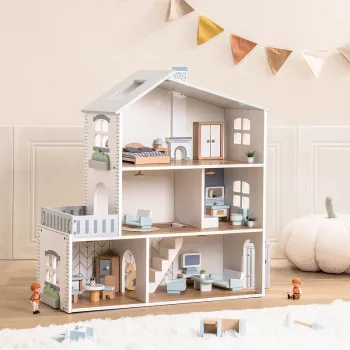
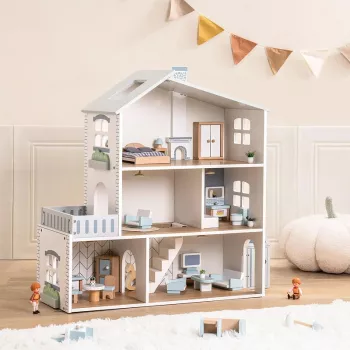
Wooden Dollhouse with 29 Accessories & Customizable Lighting
A wooden dollhouse becomes more than a playset when it arrives with a full set of accessories and lighting that can be adjusted for day-and-night scenes. The Wooden Dollhouse with 29 Accessories & Customizable Lighting is built for multi-room storytelling, hands-on arranging, and cozy “lights on” moments that help kids extend pretend play from morning routines to bedtime wind-downs.
Below is a practical guide to what makes this style of dollhouse stand out, how the accessories and lighting expand play, what to check for safety and durability, and how to set it up so it stays fun (and manageable) over time.
What Makes This Dollhouse Special
- Wooden construction for stable play: A wooden build tends to stay put during repeat play sessions, making it easier for kids to move pieces room-to-room without the whole house shifting.
- 29 accessories for instant storytelling: A larger set of furniture and décor supports open-ended scenes—family routines, hosting friends, redecorating, pretend errands, and more.
- Customizable lighting for day-and-night scenes: Light changes the “mood” of play, opening up evening, bedtime, and “movie night” storylines that don’t feel the same in a fully lit room.
- Gift-ready completeness: With a generous accessory count, the set feels finished right away, reducing the need to buy extra furniture packs immediately.
Included Accessories and Play Possibilities
Accessories aren’t just extras—they’re the tools kids use to build narratives. More variety usually means more replay value: pieces can be rearranged, moved between rooms, or temporarily “stored” to create new layouts over time.
- Narrative play grows naturally: Kids can assign roles, change routines, and act out real-life moments like cooking, getting ready for school, and hosting guests.
- Fine-motor practice: Placing chairs under tables, aligning beds against walls, and organizing tiny décor pieces supports finger control and coordination.
- Works for solo or shared play: Solo play often looks like planning and organizing; shared play becomes turn-taking, negotiation, and collaborative story-building.
- Longevity tip: Keep a small “extras” box and rotate a few accessories in and out weekly to make the setup feel fresh without buying anything new.
Accessory Ideas and How Kids Commonly Use Them
| Accessory type | Common play scenarios | Skills supported |
|---|---|---|
| Room furniture (beds, chairs, tables) | Bedtime routines, hosting guests, meals, studying | Fine-motor control, sequencing, social storytelling |
| Décor items (lamps, plants, small accents) | Redecorating, seasonal themes, “new house” scenes | Creativity, categorization, aesthetic choices |
| Kitchen/bathroom pieces | Cooking, cleaning, getting ready for school | Role-play, daily-life modeling, vocabulary growth |
| Storage and organizing pieces | Moving day, tidying up, “shopping” and restocking | Planning, executive function, responsibility habits |
Customizable Lighting: Why It Changes Play
Lighting is one of those features that quietly transforms how kids use a dollhouse. Instead of a static “always daytime” setting, adjustable illumination makes it easier to signal transitions—morning wake-up, evening dinner, or bedtime settling.
- Time-of-day storytelling: Lights help kids act out routines in a logical order, which supports sequencing (“first breakfast, then play, then bedtime”).
- A calmer play atmosphere: Gentle light can make a play corner feel cozy, helping some kids stay engaged longer and play more quietly.
- More imaginative scenarios: Think power-outage stories, bedtime reading, sleepovers, “movie night,” or holiday sparkle themes.
- Caregiver-friendly: Better visibility makes setup and cleanup easier—especially when small accessories inevitably wander under furniture.
- Use and care basics: Keep lighting components dry, avoid tugging on any wires (if present), and store loose accessories so they don’t press against light elements when not in use.
Materials, Safety, and Durability Checklist
A dollhouse gets handled from every angle—kids grip the sides, lift roofs, slide furniture, and move pieces constantly. A quick safety and durability check before regular use helps play stay smooth and worry-free.
For general toy-safety guidance, refer to the U.S. Consumer Product Safety Commission’s toy safety resources at CPSC Toy Safety and the American Academy of Pediatrics tips at HealthyChildren.org.
Setup Tips for a Better Play Space
Who This Dollhouse Works Best For
Pair It with Complementary Toys
- Hands-on building and balance play: Add a small set like the Wooden Montessori Balance Toys set for stacking, focus, and spatial reasoning that complements imaginative role-play.
- Big action storylines: Vehicles can turn dollhouse play into deliveries, construction, or moving-day adventures—especially with something like the 1:20 Scale RC Dump Truck Excavator with Remote Control for Kids.
- A consistent play station: A dedicated surface helps keep the house level and makes cleanup faster; an option like the L-Shaped 50-Inch Gaming Desk with CPU Storage & Side Bag for Home Office can create a reliable play-and-display corner in a multipurpose room.
FAQ
Does the lighting stay on during play, and how is it powered?
The lighting is designed to be used during play scenes, and it’s typically battery-powered for flexible placement. Check the product page for the exact power method, battery type, and whether batteries are included.
Are the accessories small parts that require supervision?
Many dollhouse accessories are small parts, so supervision is recommended for younger children. Always follow the age guidance and safety warnings listed on the product details.
How can the dollhouse be kept organized with so many pieces?
Use a simple tray-and-bin system: a tray for pieces in use, a bin for extras, and quick labels by room if helpful. A two-minute end-of-play reset (returning pieces to their “room” or bin) keeps clutter from building up.










Leave a comment